2026: The Year the IDE Died
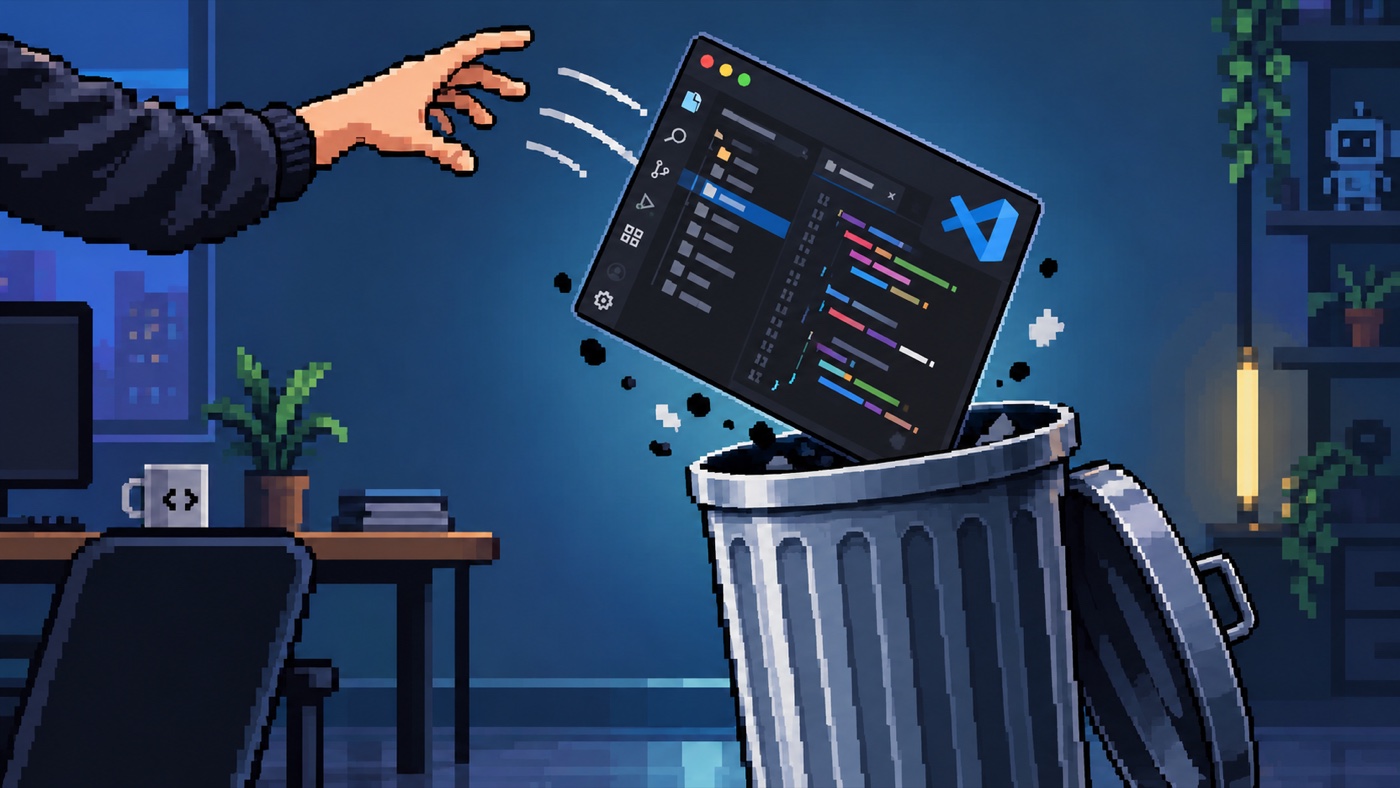
I’ve spent most of my career reaching for the lightest editor in the room — notepad, vim, where the thing in front of you is the text and nothing else. Sublime Text is old at this point, but it’s C++ under the hood and fast in a way that still impresses me. And at the start of this year I was sitting in GoLand: a JVM IDE with every battery included, the single heaviest tool I could have picked.
I’ve barely opened it since spring. Not because I finally came around to my own taste — because the agents got good enough that the question stopped mattering.
AI: The autocomplete era (2023 – 2025)
Early GitHub Copilot autocomplete worked, in a narrow way. It was great for boilerplate: function and class signatures, unit tests, anything repetitive. But when I was trying to write something from scratch, it got in the way more than it helped. I turned it off a lot.
Then I saw what Cursor was doing — generating code through chat, letting you review the diff, iterating from there — and thought, this is how it’s going to be. Chat existed elsewhere by then, but nobody had built the loop as well. Once you get used to working that way, going back feels unbearably slow.
VS Code followed shortly behind, and on paper it was the obvious place for me to land: quick enough, a mostly open-source core, good plugins, and it kept pace on AI. JetBrains was in last place — powerful, batteries included, and slow and cumbersome to sit in all day, a heavyweight JVM IDE that crashed constantly and was consistently behind on the AI stuff. That’s where my frustration started.
Eventually VS Code caught up, with Copilot built right into it. As of this writing I’d guess most engineers I know are working that way. It became my default for a while too.
And yet the year opened with me back in GoLand, because its Go support is genuinely excellent — deep built-ins, click-through navigation on anything. Batteries included won out. It had Copilot bolted on, but the AI features always trailed the frontier by a release or two. That was the trade I was still willing to make in January.
AI: The small-chunks era (January – March 2026)
The workflow back then was chunking. “First let’s do the data model.” Review it. “Now this route for the web API.” Run just those tests. Back and forth: no, try this approach, do this instead. You had to keep the pieces small because you had to review every one of them. That was the reality through the Opus 4.5 and 4.6 generation, and definitely with Sonnet — which is what I started on.
The IDE was genuinely useful for this. The code was right there next to the chat.
AI: The full-throttle era (spring 2026 – now)
But as the models got better — from around March, and especially over the summer — I found I needed the editor less and less. I wasn’t editing code anymore. I was reading diffs, occasionally clicking through to understand what the agent had done.
The harness got slow. Running several things at once and keeping the context straight was hard. At some point I realized the IDE wasn’t helping me, it was in my way.
A coworker turned me on to an open-source tool called OpenCode. The appeal: it runs any model — OpenAI, Anthropic, the Chinese models, and locally hosted ones. And because it’s open source, you can edit the tool, harden it, and make it fit whatever security requirements you’re working under. (Obviously you don’t send anything to servers you don’t trust. It has to be a trusted environment.)
I started using it and liked it immediately — but I still wanted the IDE around, to trick myself into believing I had some control over the code. That I was still hand-chiseling some of it. I wasn’t. And I’d venture that most engineers working near the frontier of this stuff aren’t either.
The real click came when I let go of the small pieces. The models — Opus 4.8 especially — got good enough that you can hand the agent a whole task, and if you’ve set things up right, it just runs. It runs the tests. It checks CI. Once that was true, the IDE had nothing left to do.
Long live the terminal
On top of that: I love the terminal. It’s just a great place to work. Unix-style commands, vim, the OpenCode color scheme. I move extremely fast there. I can spin up multiple git worktrees, let them run, and get pinged when something needs input.
For review I use a diff viewer — GitHub Desktop is great for this, and OpenCode has one built in too. If I don’t like something, I tell the agent, it tweaks it, I look again.
Sometimes I’ll kick off the same problem three different ways in three different worktrees, then pick the one I want or steer it further and throw the rest away. Code is disposable now. It’s cheap. Don’t get attached to it.
The one thing I do miss is the debugger. GoLand — and VS Code to some extent — have great debugging support and the ability to step through code, and for truly complex codebases and situations that still has a place. But I’ve found AI to be increasingly good at debugging, or at least at pointing a human in the right direction.
So I’m ready to declare the integrated development environment officially dead. I can live in the terminal. Vim is never going away. Long live the terminal, long live vi.