In Praise of the Block Plane
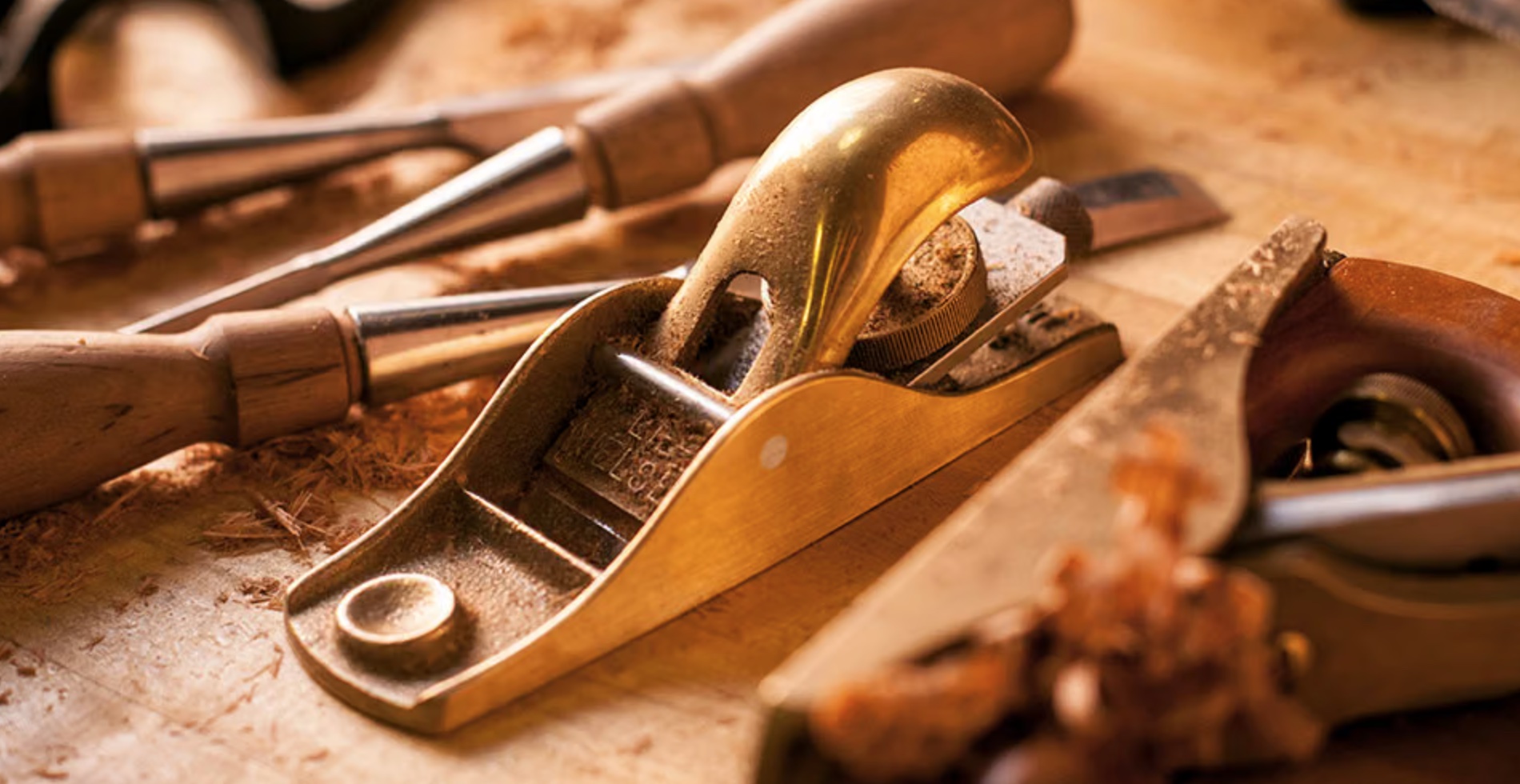
Sometimes a simple hand tool can outperform even the fanciest of power tools.
It’s just a plane, right?
Take my Lie-Nielsen block plane. It’s just a plane. A metal blade in a housing, used to shave wood. How different could one be from another?
Turns out, very. There’s a lot that goes into making a simple plane a great tool to work with.
I’d used hand planes before — basic block planes from Lowe’s or Home Depot. They mostly got the job done. The Lie-Nielsen does it with style and class. It’s the epitome of “they don’t make ‘em like they used to,” except they do, in Maine: cast iron, bronze, and an A2 hardened steel blade. The components make all the difference, and you feel it the moment you use it — more on that in a bit.
How I got here
A few years ago I wouldn’t have believed a hand tool could beat a power tool at anything. When I first got into woodworking, power tools felt like the obvious answer to everything. Faster, more accurate, less skill required. Hand tools were for the old-school masters.
I never learned woodworking properly. The closest I’ve gotten to formal training is a weekend class at Woodcraft. Other than that, Steve Ramsey on YouTube taught me the fundamentals: safety, technique, repeatability.
Steve’s whole approach is to keep it simple and get results, and I think that’s 100% the right way to go for beginners. You don’t need a cabinet-maker’s shop to build a nice bookshelf. You need a few tools, some patience, and a willingness to mess up a board or two.
I suspect even experienced craftsmen eventually hit a point where they realize simple is more elegant than complex. I’m starting to feel that way myself.
From “just enough tool” to a full shop
I caught the woodworking bug during Covid, and I’ve spent some money on tools since then. But I’ve always been pretty budget conscious about it. My rule was to never buy more tool than I needed for the job in front of me.
Somehow, one job at a time, that rule still added up to what almost looks like a full wood shop: table saw, router table, planer, jointer, track saw, the works.
One thing I’ve learned along the way: with tools, you mostly get what you pay for. There are exceptions — some of the more extravagant stuff from Woodpeckers or Laguna is priced like jewelry — but in general, spending more gets you a better tool. The block plane is proof.
Sharpening was the unlock
Hand tools are intimidating. They evoke the skill of the old master woodworkers, and a dull plane in a beginner’s hands is a frustrating thing. It took me a little while to figure out how to sharpen properly.
Once I did, it was a huge unlock. And on a good tool, sharpening is quick and simple, and the edge stays sharp for a good long while. That changes the whole relationship with the tool. It stops being a chore to maintain and becomes something you just pick up and use.
A connection to the wood
The block plane is a joy to use. It’s like having a direct connection to the wood. You can feel the grain through the tool, and you can dial in the cut until the shavings come off thin enough to see light through them.
It seems like a simple tool, but it has incredible power and versatility: chamfering an edge, easing a corner, trimming end grain, sneaking up on a perfect fit.
Power tools get the job done quickly, accurately, and precisely — especially if you pay up for the high-end stuff like Festool. But the tradeoff is real. You lose that connection to the wood, there’s dust everywhere, and your shop fills with the scream of a spinning blade.
I’m not in a hurry (when woodworking)
So these days, if I have the option to use a hand tool, I’ll take it over a power tool, even if it takes me a little longer.
I’m not doing this to make money. I’m doing it for the fun of it. And a quiet shop, a sharp plane, and a pile of translucent shavings on the bench is about as much fun as woodworking gets.