Stop Prompting. Start Building a Runbook.
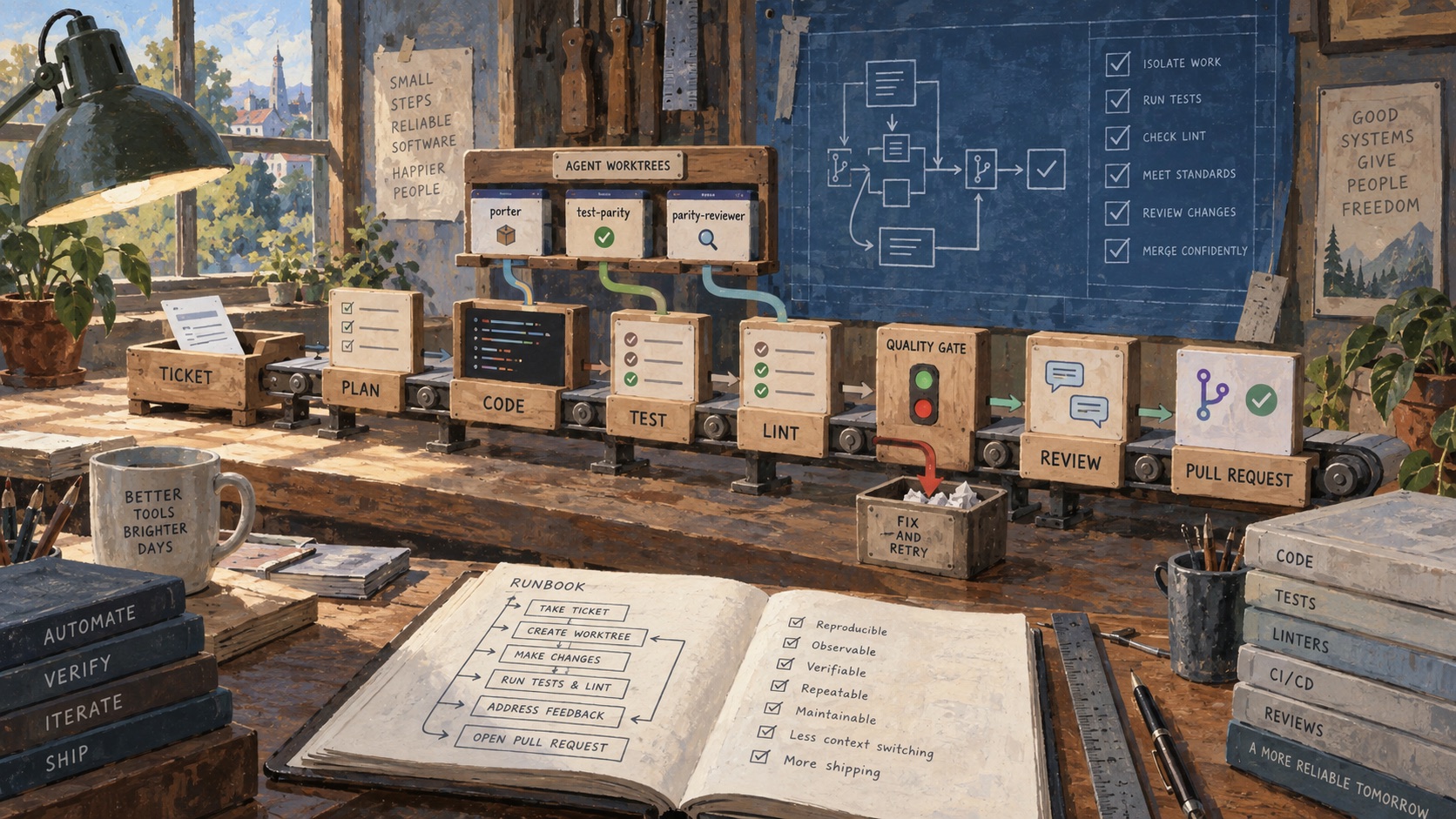
The interesting work was never the prompting. It’s building the scaffolding that makes an agent’s output verifiable and its mistakes cheap. Everything else below is downstream of that one idea.
What we were building
The service is a Go HTTP API — a build queue and dispatcher, a few hundred files, on the order of 50,000 lines of code, more than half of that test code. We were in the middle of absorbing a legacy TypeScript service into it: porting endpoints over one at a time, with behavioral parity as the whole game. Return a 500 where the old service returned a 409 and you’ve broken a caller in production.
That combination — an existing service with strong conventions, a CI/CD setup that already ran unit, integration, and end-to-end tests on every PR, and a legacy implementation that doubled as a source of truth for correct behavior — turned out to be close to the ideal shape of task for an agent. Low ambiguity, high volume. Worth naming explicitly, because it’s not the same claim as “agents solve greenfield design.” They don’t, or at least not this kind of agent, not yet.
Measured against how this work went before:
| Work category | Before | With AI | Impact |
|---|---|---|---|
| Chore-sized tasks | 1–2 days | ~1 hour | 8–10x faster |
| Complex tasks | ~1 week | 2–3 days | 2–3x faster |
| Well-scoped projects | baseline pace | AI-assisted | 3–5x faster |
The gains showed up most on repetitive, decomposable, clearly scoped work — which is a real result, but it’s also a specific one. It’s not “AI makes everything faster,” it’s “AI changes the unit economics of a particular kind of engineering work.”
The one idea underneath everything
Part of the team worked in VS Code with Copilot, I mostly worked in OpenCode. Nobody wanted two sets of rules quietly drifting apart. So the actual content — rules, scoped conventions, reusable commands, subagent definitions — lived in one shared location, version controlled like any other code, and each tool got a thin adapter that pointed at it.
| Artifact | Source of truth | OpenCode | VS Code / Copilot |
|---|---|---|---|
| Repo-wide rules | AGENTS.md, .github/copilot-instructions.md |
read automatically | read automatically |
| Scoped conventions | .github/instructions/*.instructions.md |
matched by an instructions glob | matched by an applyTo glob |
| Subagents | .github/agents/*.agent.md |
referenced from opencode.json |
read automatically |
| Reusable commands | .github/prompts/*.prompt.md |
a one-line stub in .opencode/command/*.md |
read automatically as /name |
| MCP servers (issue tracker, wiki) | — | opencode.json |
.vscode/mcp.json |
The content itself lives under .github/, and each tool’s adapter is a few
lines at most. .opencode/command/lint.md, for example, is nothing but a
stub that captures its arguments and pulls in the real prompt from
.github/prompts/lint.prompt.md — Copilot reads that same shared file
natively as /lint. One playbook, two front doors.
Rules written as scars, not aspirations
Every rules file I’ve seen looks like a wish list by default. Ours read more like a runbook — the standard I held it to was: if you can’t name the incident behind a rule, cut it.
A few examples, paraphrased: handlers decode, call the service layer, and encode — no business logic in the handler. Use the shared test-database harness for anything touching persistence, not a hand-rolled one per test file. Don’t add error handling for conditions that can’t actually occur. Each of those exists because something specific went wrong once, not because it sounded like good practice in the abstract. And when a newer model shows up, it’s worth going back and asking whether the rule is still earning its place — some of it was scaffolding for a weaker model that a better one doesn’t need anymore.
Commands: the autonomy dial isn’t one setting
The most useful command in the whole setup takes a ticket and walks it end to end: read the ticket, cut a fresh worktree (never work in one that’s already there, even if it looks clean), classify and route the work, get a parity sign-off if it’s a port, then ship it — commit, push, open the PR, comment the link back on the ticket. The line that actually makes it work is the one telling it not to stop and ask permission between steps: read out what’s coming, then keep going all the way to an opened PR, and only stop for a genuine blocker.
You can always throw away a worktree. You can’t get back the twenty minutes you spent typing “yes, continue.”
Compare that to the linting command, which is almost the opposite
philosophy on purpose. Mechanical, reversible fixes — formatting, an
unchecked deferred Close(), an unused assignment — get auto-fixed.
Anything that needs judgment — a nil context where a real one was in scope,
a dead check, a coincidental type conversion — gets reported, not touched.
Never chase a green exit code for its own sake; if a “fix” would make the
code worse, don’t make it. The point isn’t that one command is more trusted
than the other. It’s that the autonomy dial should be set by how expensive
and how reversible a mistake would be, not by a blanket feeling about the
model.
Four narrow subagents, not one helpful one
Instead of one general assistant, the actual work was split across a small number of narrowly scoped subagents:
| Subagent | Job | Write access |
|---|---|---|
| porter | Port a single endpoint | edit |
| test-parity | Write the parity tests for it | edit |
| parity-reviewer | Read-only gate before a PR goes up | none — diff/log/test/lint only |
| spike-researcher | Investigate, write up findings | docs only |
None of them are allowed to assume a path. If a subagent can’t locate something with a quick directory scan, it asks rather than guesses. Small rule, but it eliminates a whole category of confidently-wrong behavior.
The verification surface is the whole trick
Nothing in this setup calls a raw test runner directly. Every check is a named target that both your laptop and CI run identically:
make lint        make test
make vuln        make cover
make integration-local
make api-smoke
The agent isn’t a special case that needs a separate trust model. It’s a third user of an interface that already existed for humans. You’re not asking “do I trust the model.” You’re asking “does it pass the gates” — the same question you already ask of a human’s PR.
The strongest version of this: on every PR, CI also runs the old service’s own end-to-end test suite against the new one. The thing being replaced grades its replacement. That’s why the test-to-source ratio here is over 1:1 — the port is only worth doing if the safety net is denser than the code it’s protecting.
Two war stories
The guardrail that did nothing. I tried to tidy up permission configuration by moving it from one place into what looked like a cleaner, more idiomatic location. Nicer diff. Except one of the two tools only parses that configuration from a specific file format in a specific location — and silently ignored the version I’d moved, running the “read-only” agent with full default permissions instead. I only found out because I went and actively probed it: gave the agent a task that should have been blocked and watched it not get blocked.
A safety setting you’ve never tested is a safety setting you don’t actually have.
The test that passed doing nothing. A test meant to verify every route was documented in the API spec lived in the wrong package for months. It still ran. It still passed. It just wasn’t testing anything, because it was importing the wrong set of routes entirely. A green test that verifies nothing is worse than no test, because it buys you confidence you didn’t earn — and it’s the exact same failure mode as trusting a model’s output because the output looked plausible. The signal looked right, so nobody looked closer.
Running several agents means solving a concurrency problem
Once you’re cutting a fresh worktree per task, running several agents at once is mechanically possible — until they collide on something shared. In our case it was a local dev stack bound to fixed ports: two agents both trying to run the full service locally at once was a bad afternoon. The fix was the same fix you’d reach for with any shared mutable resource — eliminate it. Default parallel work to unit and integration tests against an ephemeral, per-run database instead of the shared stack. A few extra seconds of boot time per run bought effectively unlimited concurrency.
The other resource that turned out to be scarce was context. A large design document was getting pulled into every task’s context window whether or not the task had anything to do with it. Worth a section of its own in the rules file: lazy-load it, don’t preload it. Spend context on the task in front of you, not on documents that merely might be relevant.
Five things worth stealing
- Put the actual content in one place and give each tool a thin adapter. Don’t maintain two brains.
- Every verification step should be a named target that CI runs identically. This is most of the trick.
- Write rules as scars, not aspirations. If you can’t name the incident, cut the rule.
- Set the autonomy dial per task, not per tool — same repo, same model, opposite settings depending on how expensive a mistake would be.
- Test your guardrails the same way you test your code. A restriction you’ve never verified is not a restriction.